
Summer Assignment Information for AP Classes
View summer of 2026 AP class assignments.
AP Lit
Contacts: Ms. Prather | [email protected] & Ms. Yarbough | [email protected]
Dear Future AP Literature Students,
We are so excited to be going on a literary journey with you next year!
AP Literature and Composition is all about building your skills in analyzing complex literature from a variety of time periods and viewpoints. One of the major elements of the AP Lit Exam is the literary argument essay; for this essay, students must choose a text from their own memory that fits the prompt in order to craft their response. The options on the summer reading list are designed to be helpful in multiple ways: to expand students’ pool of appropriate texts to pull from for their AP Exam, to familiarize students with some of the style and complexity of writing they will be working with in class, and to provide an enriching and enjoyable reading experience.
For your summer assignment, select one of the books from the list and complete the following tasks:
- Read & annotate your book; you may write directly on the book, use sticky notes, or keep a separate handwritten annotation journal (annotations will be checked for informative feedback)
- Complete the Reading Journal packet (multiple formative grades)
- Be prepared to use your text for a graded in-class timed writing assignment on Sept. 8/9.
Reading, annotating, and completing your Reading Journal packet over the summer will allow you to save time at the start of the school year, but you will have some time to complete the assignment once school starts; annotations and the Reading Journal will be accepted for credit during the first two weeks of school, through Sept. 8/9 (whichever day you have English class).
If you have any questions, either about the summer reading or the course in general, please don’t hesitate to reach out. We look forward to seeing you all in August!
AP Literature: Summer Reading Choices
You should select one of the books below to read & annotate for your summer assignment. Please note that many of these books include content that is sensitive to readers. You should have a conversation with your parent or guardian regarding your book selection. If you have any questions about the book options, please do not hesitate to contact either Ms. Prather ([email protected]) or Ms. Yarbough ([email protected])
Available to check out from the English Department:
To borrow one of these books for the summer, see either Ms. Prather in Room 1112 or Ms. Yarbough in Room 1105 before the end of the school year.
Little Fires Everywhere by Celeste Ng (2017)
Set in 1990s suburbia, this novel follows two families: the wealthy Richardsons and their renters, single mother Mia Warren and her teenage daughter Pearl. It explores complex issues of wealth, race, and motherhood.
The Curious Incident of the Dog in the Night-Time by Mark Haddon (2003)
This mystery novel is told from the point of view of Christopher, a neurodivergent teenager dedicated to uncovering the truth behind the suspicious death of his neighbor’s dog. In the process, he uncovers family secrets of his own.
Students must get their own copy:
Homegoing by Yaa Gyasi (2016)
Ghanian-American Gyasi’s debut novel tracks a family’s divergent path beginning with two half-sisters: Effia, who marries an influential British colonial leader, and Essi, who is held captive and sold into the slave trade. Each chapter tells the story of a new descendant of the family, from 18th century up through the present day.
Never Let Me Go by Kazuo Ishiguro (2005)
This science-fiction novel focuses on an alternative-reality version of an English boarding school; students have minimal contact with the outside world, and all it not what it seems. This text explores themes of memory, friendship, and what it means to be human.
Circe by Madeline Miller (2018)
This retelling of events from the Odyssey (and other classical Greek myths) focuses on the perspective and experiences of Circe, daughter of the titan Helios and witch infamous for transforming men into pigs, as she comes into her own.
AP Lang
Contact: Mrs. Ortiz | [email protected]
Due Date: Tuesday, September 1
Click to download the assignment (.docx)
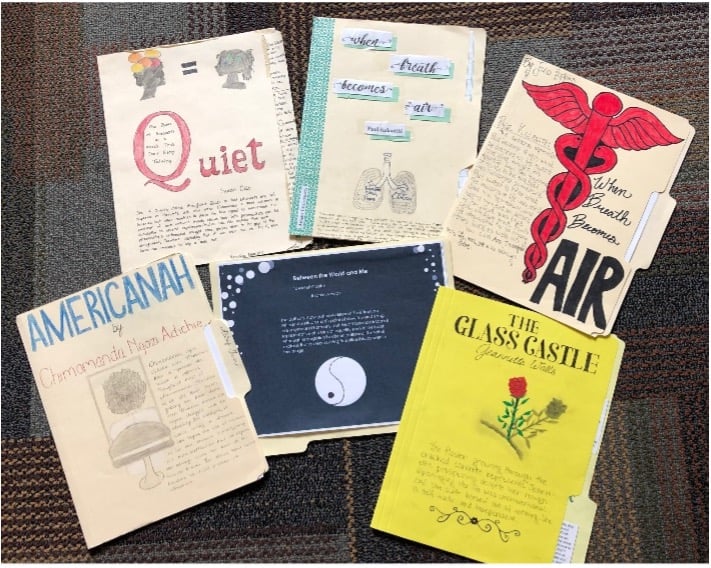
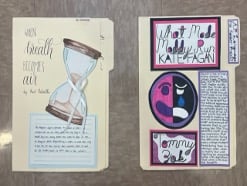
For this assignment, create an analytical nonfiction text file folder using the text list below. As you read, take note of the book’s rhetorical choices, or ways in which the author presents or enhances a story or argument; its structure; lines of reasoning; and rhetorical situation. After reading, you will demonstrate your learning through a file folder project through the components listed below. This project is designed to introduce you to rhetorical analysis and close reading skills central to AP English Language and Composition. Successful projects will move beyond summary to analyze how authors use language, structure, and rhetorical choices to shape meaning and influence readers.
Your folder should be organized, legible, and thoughtfully assembled. Creativity and visual presentation matter, but strong analytical thinking and textual engagement are most important. While you may discuss your book with others, your written work should be original and independently composed. All written responses should reflect your own thinking and analysis. AI is not permitted for this assignment.
Student Samples
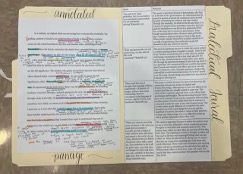
Folder Directions:
| Location on Folder | Directions |
|
FRONT of folder (Symbol) |
❖ Write the title & author on the front ★ Draw an image that you think represents one of the major ideas/themes/people in the book you read. Near the symbol, write the theme, idea, or person’s name and a well-crafted 5 – 7 sentence explanation of how the symbol is representative of this element of the text. Avoid choosing symbols that are overly obvious or generic. Strong symbols reveal something meaningful, complex, or nuanced about the text and should connect clearly to the author’s larger message or purpose. ➔ Write your name somewhere on this side. |
|
BACK of folder (WE CAMP analysis) |
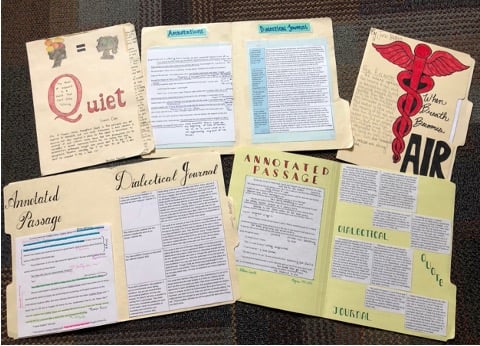
On the back of your folder, write the acronym WE CAMP down the side. Your responses should focus on analysis rather than plot summary. In strong rhetorical analysis, you explain not only what the author does, but why those choices matter and how they shape the reader’s understanding of the text. For each letter, you must write a concise, thoughtful paragraph (approximately 3–5 sentences) for each component detailing: W - important/relevant information about the writer E – exigence: the moment, event, situation, or issue that prompted the author to write the book C - year of publication and relevant historical/cultural context; the setting of a non-fiction text A - the author’s intended audience and their needs/beliefs/values; the author’s relationship to this audience M- the message of the text; this would include a summary to communicate the content P - a purpose statement describing what the author wants the book to achieve or accomplish INSIDE LEFT of folder |
|
INSIDE LEFT of folder (Annotated Passage) |
Type or copy, annotate, and cite one passage from the book that you found particularly moving or important, and which exemplifies the author’s writing style. The passage should be approximately two-thirds (2/3) to a full page when double-spaced. This passage should be in the middle/end of the text, near the tonal shift Annotate by highlighting, circling, boxing, and/or underlining important aspects of the text, then adding notes in the margins about the words you marked. Think about how the author achieves their purpose through this piece of writing. Look for powerful diction, appeals, syntax (sentence structure), figurative language, allusions, etc. Strong annotations go beyond labeling devices; they explain how the author’s choices contribute to tone, purpose, meaning, or impact on the audience. |
|
INSIDE RIGHT of folder (Mini Dialectical Journal) |
Divide the inside right folder into two columns. Choose 4 meaningful short passages from your book. Each quote should come from a different quarter of the book (approximately). Write these passages in the LEFT column. In the RIGHT Column, write a 100 word (minimum) response to each quote. Why is this an important quote? How does it contribute to the meaning of the text? Effective responses should analyze the quote’s significance rather than simply summarize the surrounding events in the text. Quote (page #) |
List of Texts
Choose a text from the list below to complete your project. You are welcome to listen to an audio book; however, you will need to refer to a printed copy for the close reading activities required for this assignment. Please note: some of these books may contain content that is sensitive to readers. Make sure you have a conversation with your parents or legal guardian about your book selection!
Note: Most texts exist in more than one category
If there is a text that you want to read that is not on this list, please email Mrs. Ortiz for approval. You can reach her at [email protected]. Please note that she will veto any text covered in 9th and 10th grade.
Autobiography/Memoir
- I Know Why the Caged Bird Sings - Maya Angelou
- Educated - Tara Westover
- Crying in H-Mart - Michelle Zauner
- Hunger: A Memoir of (My) Body - Roxane Gay
- A Long Way Gone: Memoirs of a Boy Soldier - Ishmael Beah
- Farewell to Manzanar - Jeanne Wakatsuki Houston and James D. Houston
- Dreams from My Father: A Story of Race and Inheritance - Barack Obama
- Fresh Off the Boat: A Memoir - Eddie Huang
- Bento Box in the Heartland - Linda Furiya
- Somebody's Daughter: A Memoir - Ashley C. Ford
- Black Dove: Mama, Mi’jo, and Me - Ana Castillo
- Barbarian Days: A Surfing Life - William Finnegan
- Beautiful Country - Qian Julie Wang
Class and Money
- Nickel and Dimed: On (Not) Getting By In America - Barbara Ehrenreich
- Somebody's Daughter: A Memoir - Ashley C. Ford
Race
- I Know Why the Caged Bird Sings - Maya Angelou
- The Heritage: Black Athletes, a Divided America, and the Politics of Patriotism - Howard Bryant
- Bento Box in the Heartland - Linda Furiya
- Black Dove: Mama, Mi’jo, and Me - Ana Castillo
- Between the World and Me - Ta-Nehisi Coates
History
- The Power of Babel - John McWhorter
- Farewell to Manzanar - Jeanne Wakatsuki Houston and James D. Houston
- A Long Way Gone: Memoirs of a Boy Soldier - Ishmael Beah
- Reading Lolita in Tehran - Azar Nafisi
- Stamped from the Beginning: The Definitive History of Racist Ideas in America - Ibram X. Kendi
- All That She Carried: The Journey of Ashley’s Sack, a Black Family Keepsake - Tiya Miles
Food and Nutrition
- Fast Food Nation: The Dark Side of the All-American Meal - Eric Schlosser
- Animal, Vegetable, Mineral: A Year of Food Life - Barbara Kingsolver
- Hunger: A Memoir of (My) Body - Roxane Gay
Science
- Braiding Sweetgrass: Indigenous Wisdom, Scientific Knowledge and the Teachings of Plants - Robin Wall Kimmerer
- Stiff: The Curious Lives of Human Cadavers - Mary Roach
- Everything Is Tuberculosis - John Green
- How Far the Light Reaches - Sabrina Imbler
- Astrophysics for People in a Hurry - Neil deGrasse Tyson
Essays
- The Awkward Thoughts of W. Kamau Bell: Tales of a 6' 4", African American, Heterosexual, Cisgender, Left-Leaning, Asthmatic, Black and Proud Blerd, Mama's Boy, Dad, and Stand-Up Comedian - W. Kamau Bell
- How Far the Light Reaches - Sabrina Imbler
- Stamped from the Beginning: The Definitive History of Racist Ideas in America - Ibram X. Kendi
- The Undocumented Americans - Karla Cornejo Villavicencio
- Between the World and Me - Ta-Nehisi Coates
Comedy
- The Awkward Thoughts of W. Kamau Bell: Tales of a 6' 4", African American, Heterosexual, Cisgender, Left-Leaning, Asthmatic, Black and Proud Blerd, Mama's Boy, Dad, and Stand-Up Comedian - W. Kamau Bell
- Why Is Everyone Hanging Out Without Me- Mindy Kaling
- Fresh Off the Boat: A Memoir - Eddie Huang
Sports
- The Heritage: Black Athletes, a Divided America, and the Politics of Patriotism - Howard Bryant
- Moneyball - Michael Lewis
Crime
- Know My Name - Chanel Miller
AP Seminar
Contact: Ann Johnson | [email protected] & Eunice Jang | [email protected]
Video | Parent Meeting
Things Fall Apart by Chinua Achebe
Download the assignment here (.docx file)
Dear Parent or Guardian,
We are excited to welcome your student to AP Seminar English 10 next school year! AP Seminar is a foundational course that engages students in cross-curricular conversations that explore the complexities of academic and real-world topics and issues by analyzing divergent perspectives. Using an inquiry framework, students practice reading and analyzing articles, research studies, and foundational, literary, and philosophical texts. Throughout the program, students consider and evaluate multiple points of view to develop their own perspectives on complex issues and topics through inquiry and investigation. This course is designed to challenge and inspire students as they grow into thoughtful critical thinkers, writers, readers, and presenters. We are truly looking forward to the journey ahead with your child.
To help set the stage for our work together, students will begin with a summer reading assignment focused on Things Fall Apart by Chinua Achebe. As they read, they’ll be asked to consider the novel’s multiple perspectives and reflect on how Achebe explores the complexities of culture and change. This powerful text will serve as the foundation for our early class discussions and activities. While the assignment is not due until the second class of school, it’s in your student’s best interest to complete it over the summer. The assignment can be found on the school website, and your child also received a copy via email. They should complete the assignment using that digital version and submit it to the assignment in Canvas.
If your student has any questions before summer break begins, s/he is free to stop by our rooms.
Mrs. Jang | [email protected] | Room 1111
Mrs. Johnson | [email protected] | Room 1103
Thank you for your support, and we hope your family enjoys a restful and refreshing summer. We look forward to meeting your student in August!
Sincerely,
Mrs. Jang & Mrs. Johnson
AP Seminar Teachers
Patriot High School
AP Research
Contact: Ann Johnson | [email protected]
Video | Parent Meeting
Overview
It is vital that you choose a topic that you are truly interested in and not just one you think will be easy. AP Research is an opportunity to choose a topic of your choice. With that said, I have found that students are more successful when they choose topics that are not related to recent AP Seminar stimulus; thus, projects about social media, prisons, fast fashion, monuments, and immigration will not be our focus.
When thinking about research, consider the problems you see around you. It could be a problem in the school, your community, how efficient/effective a product or process is, how movies project a certain stereotype or create a prototype to solve some issue or problem that exists. For example, a high scoring paper analyzed the Black Widow Marvel movies by looking at how Black Widow was portrayed. In a previous year, a student studied the traffic patterns in high schools to see what the most effective way is to reduce wait times in the parking lot before school. Last year, a student studied the motivation of song lyrics while running, and another student grew plants in recycled glass to see if it was a viable replacement for soil. Your options are endless.
To begin preparing for next year, I ask that you complete the following, so you are ready to begin the first day of school. There will be a summative the second week of school for the reading.
Reading
- Read pgs 1-8 from "The Nature and Tools of Research" .You may stop at Philosophical Assumptions Underlying Research Methodologies.
- Read pgs 30-32 from "Finding Research Projects".
- Read the following high scoring AP Research Papers
- Mediterranean Diet
- Mama Mia pt. 1 & pt. 2
- Shoe Erosion
- Termites
- Dye pt. 1 & pt. 2
Student Interest Inventory
- Complete the Student Interest Inventory
- It is important that you think through this list and truly find sources that are interesting to you. This will drive your ENTIRE research project, so spend some time really thinking through the sources.
- Complete Parts 1-4 before coming to the second class.
- This will be a summative grade.